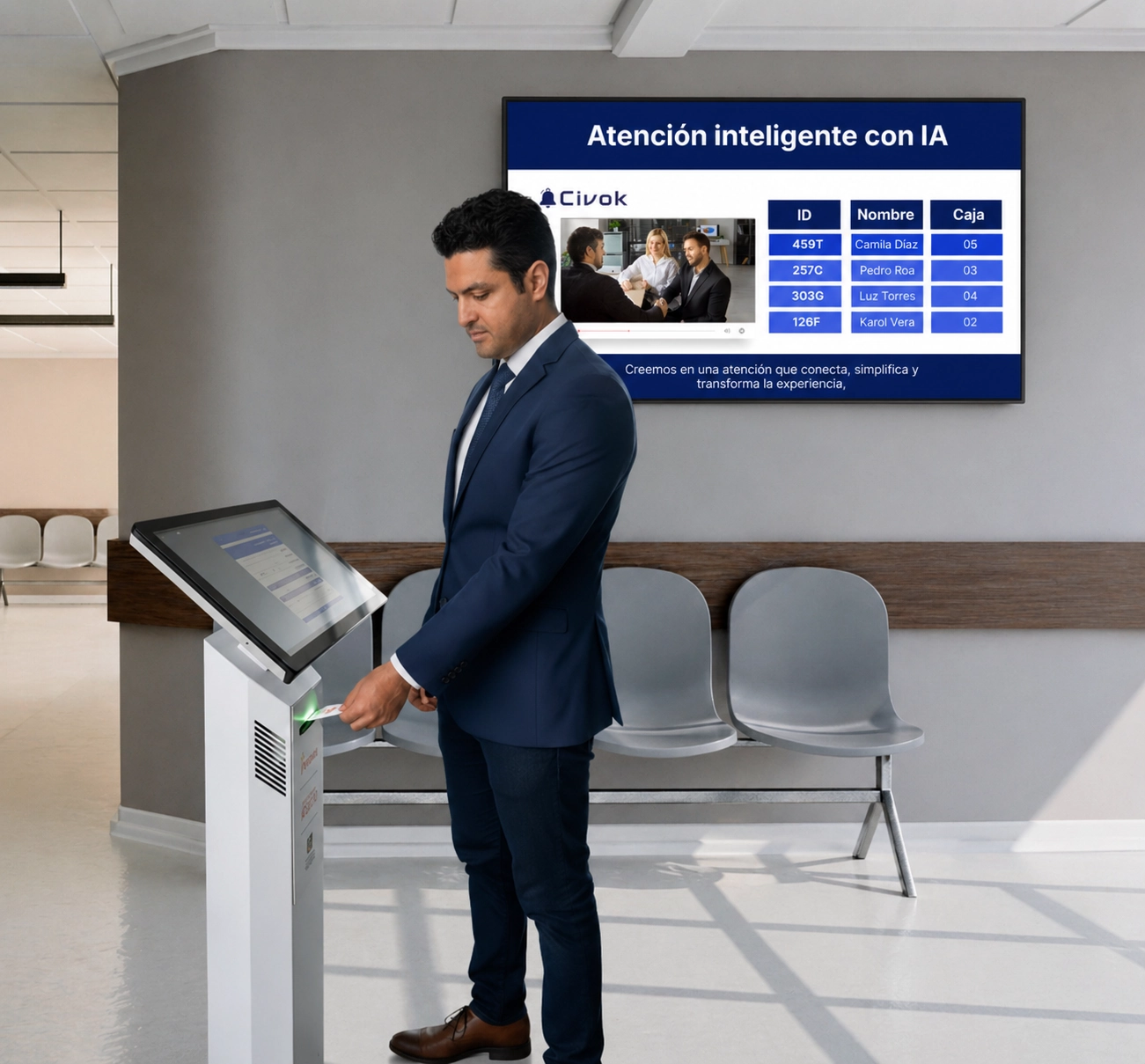
Queues no one controls
Users piling up, overwhelmed agents and complaints arriving before operations can react.
Turno DigitalIA connects queues, appointments, WhatsApp, kiosks, displays, video service, analytics and AI-assisted workflows to guide users, prioritize services and give operations control from day one.

Turno DigitalIA by Electronika is an intelligent omnichannel service platform that integrates queues, appointments, WhatsApp, self-service kiosks, call displays, video consultations, analytics and conversational AI to organize the user experience, support AI-assisted guidance, anticipate bottlenecks and measure operations in real time.









Technology designed to scale and support the continuous operation of your business.
Design and integration of complete technology projects, combining electronics, mechanics, software and specialized installation.
Turno Digital integrated with kiosks, displays and signage manufactured by Electronika, with no third-party dependencies.
Local technical support from installation through stable operations, with hands-on support in Colombia.
Self-service devices and signage designed and configured to work with Turno Digital from day one.
Over two decades delivering projects for public and private sector organizations in Colombia and Latin America.
When channels are not connected through AI, data and operational rules, users repeat requests, teams improvise and operations react too late.
Users piling up, overwhelmed agents and complaints arriving before operations can react.
WhatsApp, web, phone and in-person channels operate in silos. Users repeat their requests, teams improvise and the experience loses value.
By the time a report appears, the user has already waited, complained or left. Operations do not measure what they need in real time.
Electronika designs, manufactures, programs, installs and supports the complete solution. No third parties are needed to connect the software with kiosks, displays and signage.
Omnichannel platform connecting all in-person and virtual service flows.
Made in Colombia. Touch-screen totems with ID reader, printer and camera pre-configured.
Digital signage integrated with the queue system for waiting areas and locations.
Electronika installs, configures, trains and supports the operation with local technical assistance.
A clear journey for the user and a measurable operation for the organization.
The user messages via WhatsApp, visits the website or arrives directly at the location.
The system validates availability, service type, location, time slot and priority.
The user receives their queue number, appointment or QR with clear instructions on their phone.
Identifies at the kiosk with QR or ID and enters the in-person or remote service flow.
The display, the agent and the system work synchronized on the same flow.
Operations analyze times, satisfaction, productivity and bottlenecks.
Turno Digital adapts to the operational reality of each sector in Colombia.

Shorter waits for patients. Triage, emergency, lab and consultation coordinated from a single system.

Organized, traceable and measurable citizen service. SIAU and Supersalud compliance support.
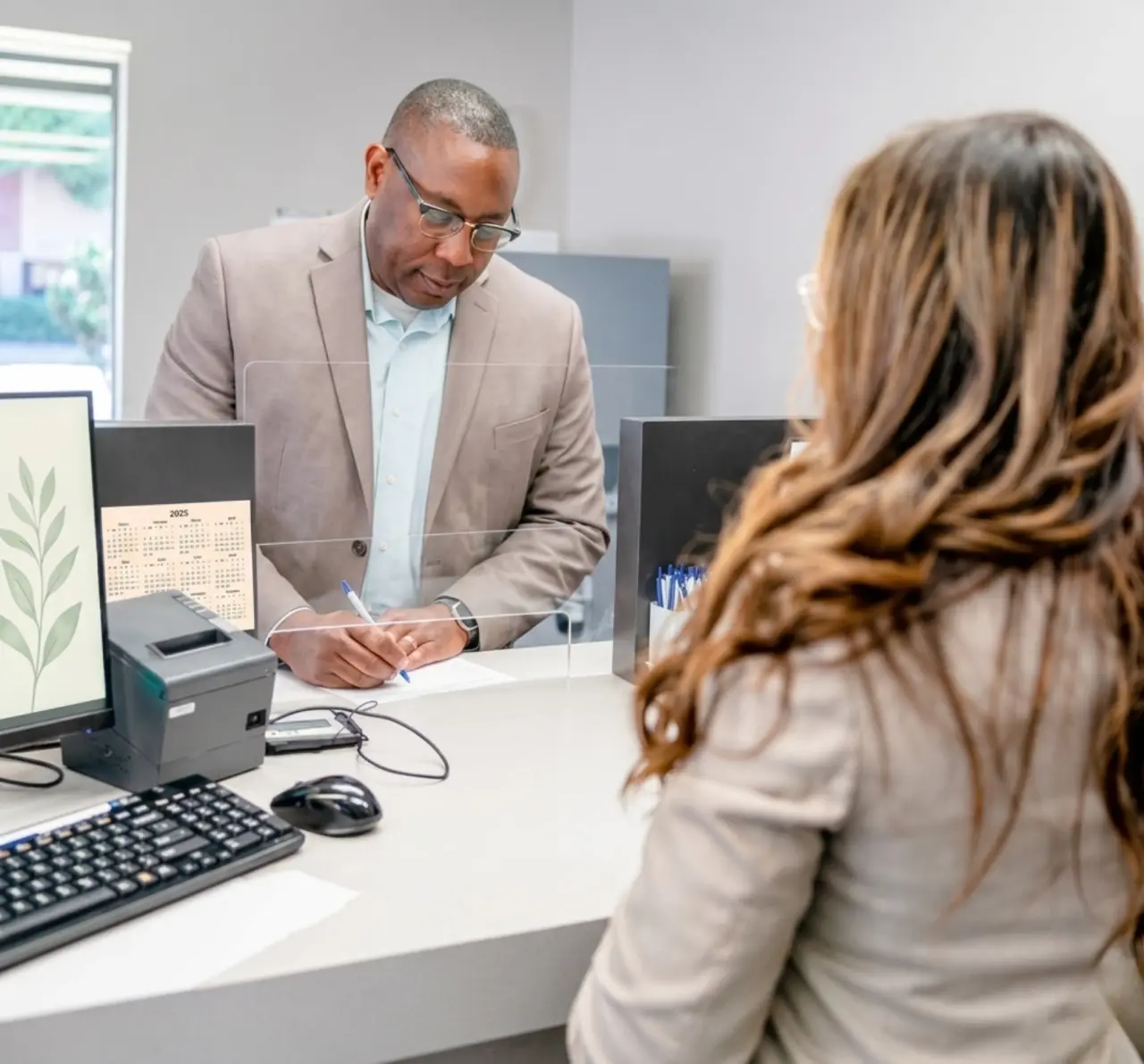
Branch queue control, prioritization and analytics to reduce service times.

Structured service flows for stores, service centers and points of sale.

Guidance, service and flow management across campuses, faculties and university locations.
Articles from the Turno Digital team on real-world operations.
Proven strategies to reorganize outpatient and emergency service with queue management technology.
Read articleHow public sector organizations structure citizen service with modern queue management systems.
Read articleFrom chat to in-person service: how WhatsApp Business API integrates with queue management.
Read articleResolve questions about queues, appointments, kiosks, call displays, WhatsApp, operational analytics and support before starting your project.
It should review locations, entry channels, services, wait times, service points, displays, kiosks, available staff and required reports. With that foundation, Electronika can design a flow that connects software, hardware and installation.
When operations need to connect queues, appointments, displays, kiosks, WhatsApp, QR, reports and physical installation. In those cases, Electronika delivers a complete solution, not an isolated component.
Electronika can configure the platform, manufacture or integrate hardware, install displays, set up kiosks, connect digital signage and support the go-live. This reduces friction between technology and operations.
It starts with the real user journey: how they arrive, what they need, where they wait, who serves them, how they are called and how results are measured. The flow is then designed with queues, appointments, kiosks, QR, displays, WhatsApp and analytics.
Yes. It can organize locations, services, priorities, users, modules and reports by site. This enables local control at each location and a centralized view of the entire operation.
That manual flow can be the starting point. Electronika identifies bottlenecks and transforms the process into a measurable digital operation without forcing an overnight change.
Yes. An organization can start with in-person queues and displays, then add kiosks, QR, appointments, WhatsApp, analytics or integrations. This allows growth without disrupting existing operations.
Typically operations, customer service, IT, infrastructure, communications and management. If physical locations are involved, maintenance, security and user experience teams should also participate.
The kiosk can handle check-in, service selection, data validation, ticket printing or arrival confirmation. Electronika integrates software with hardware so users can start their service journey without always depending on reception.
Kiosks reduce congestion at reception, organize arrivals, minimize classification errors and capture data from the start of the flow. They also help separate services, priorities and service types.
Yes. Depending on the project, it can include a document reader, camera, thermal printer, touchscreen or validation devices. The configuration depends on the process and the level of identification required.
Electronika can participate in design, manufacturing, integration, installation and support of kiosks or totems. This means the project does not depend solely on software but on physical infrastructure aligned with operations.
It needs a clear interface, appropriate height, readable screen, fast response, simple instructions, reasonable accessibility and a stable connection to the system. The experience should avoid unnecessary steps.
Yes. A small location can use a compact self-service point, while a high-traffic site may need robust totems, multiple check-in points or integration with call displays.
A QR can enable arrival check-in, appointment confirmation, queue lookup, instructions or access to a digital flow without going through reception. This helps reduce queues and wait times.
Not always. QR may be sufficient for users with a smartphone and clear data. The kiosk remains useful for in-person guidance, printing, document validation or a guided experience on site.
Yes. A user can scan a QR at the location to confirm arrival, validate the service and enter the call flow. This distinguishes scheduled appointments, walk-in users and priority cases.
Each user can choose the most convenient path: scan from their phone, register at a kiosk or receive guidance. Displays complete the journey by showing call numbers and instructions.
Yes. When users start the process from their phone, reception is no longer the only entry point. This distributes demand and allows staff to focus on assisted cases.
Displays can show queue numbers, modules, services, institutional messages or location directions. Electronika integrates the visual signal with the system so calls are clear in the waiting area.
Yes. The organization can define different messages, queues, guidance or content by location, room, service or floor. This is useful when there are multiple service areas or different user paths.
A call display is connected to the operational flow and shows queue numbers, modules or instructions. An informational display communicates general content. Many projects combine both functions.
It depends on the current infrastructure. Electronika can review existing displays, media players, network, formats and software to determine whether to integrate, upgrade or deploy a new architecture.
Visibility, reading distance, lighting, size, height, angle, audio, foot traffic and content must all be considered. A poorly placed display can create confusion.
Yes. In large facilities, call displays can be complemented with directional guidance toward rooms, modules, floors or zones. Electronika can integrate screens, totems or signage to better guide users.
WhatsApp can guide, confirm, remind, schedule or send instructions before the visit. On-site, it can connect with queues, appointments, QR or displays to avoid isolated channels.
Yes. The goal is not to replace all channels but to connect them better. Web, WhatsApp, in-person service, phone, kiosks or reception can all be integrated into a more structured flow.
Yes. Operations can receive scheduled and walk-in users by applying priority rules, time slots, services and available capacity. This prevents one channel from disrupting the other.
They can receive time, location, required documents, arrival instructions, check-in QR, contact channel or service recommendations. Good pre-visit communication reduces rework.
Yes. The system can support rules for expired appointments, rescheduling, absences or late arrivals. These rules are defined based on the service and location capacity.
It can track wait times, service times, demand by service, productivity by module, location saturation, abandonment rates, SLA compliance and channel behavior.
It identifies where users are accumulating, which services take the longest, which time slots are under the most pressure and which locations need adjustment. Without data, operations tend to react too late.
Yes. The flow can include satisfaction surveys tied to the service, location or agent. This cross-references user perception with actual times and operational results.
It means knowing what happened with each user from entry to service close: entry channel, wait time, call, service, outcome and timestamps. This supports auditing and continuous improvement.
Yes. By understanding demand by time slot, service and location, the organization can adjust staff shifts, open modules during peak hours and reduce idle time or saturation.
It can be configured to help identify excessive wait times, user accumulation, saturated services or events requiring intervention. This allows action before the problem escalates.
Depending on the case, integration with CRM, HIS, ERP, scheduling systems, databases, authentication or internal platforms can be evaluated. Feasibility depends on APIs, permissions, security and technical scope.
The appointment logic, availability, locations, services, users, permissions and shared data must be understood. It is also necessary to verify whether the scheduling system has an API or secure interoperability mechanisms.
Electronika can map existing systems and define an integration architecture. The goal is to reduce duplicate data entry, improve traceability and eliminate isolated channels.
Yes. It can be configured for administrators, agents, supervisors, location staff or report users. Each profile can have different permissions based on their responsibilities.
Yes. In complex facilities it can integrate with digital directories, directional displays or wayfinding systems to guide users to the correct point after check-in or when called.
IPS, clinics, laboratories, medical centers and care facilities can use it to organize patient arrivals, appointments, services, rooms, authorizations, payments, results or administrative processes.
It can organize citizen service by service type, location, priority and availability. It also enables time measurement, visible queue reduction and report generation for institutional monitoring.
It helps classify users by transaction type, prioritize services, organize waiting areas, connect appointments and measure service by module or location. It can also support differentiated experiences by customer profile.
Yes. It can be applied in admissions, student welfare, academic registration, financial services, student support, document delivery or administrative support during peak demand periods.
It can organize warranties, support, deliveries, technical services, priority service or specialized consultations. The goal is to eliminate disorganized queues and provide visibility into the status of each request.
Yes. It can support reception, visitors, suppliers, meeting rooms, internal services or employee assistance. Combined with QR and displays, it organizes access and communications in common areas.
It can include diagnosis, flow design, platform configuration, display installation, kiosk integration, training, testing, go-live and support. Scope is defined per project.
Electronika can support installation, testing, configuration and initial stabilization. This is critical when the project combines software with physical devices and operational staff.
The team needs to understand how to call queue numbers, manage priorities, review appointments, use reports, operate kiosks or displays and handle common situations. Training must be tailored to each role.
The project should include support, contingency procedures and internal contacts. When Electronika participates in both hardware and software, diagnosing network, device, configuration or operational issues is much easier.
Yes. It can expand to additional locations, services, displays, kiosks, digital channels or reports. The recommended approach is to design the architecture from the start with growth in mind.
Network, power, equipment placement, display mounting points, connectivity, physical security, service areas and data availability must all be reviewed. A pre-installation review prevents operational failures.
By defining clear objectives, training the team, reviewing reports, adjusting rules and measuring actual usage. Technology must be accompanied by operational management.
Because many operations need more than a platform — they need a solution connected to devices, displays, kiosks, installation, support and on-site experience. Electronika approaches the project as a complete system.
Share the basic details of your project and our team will identify the best way to support you.